Proper pruning preserves tree health, improves structure, and reduces long-term risk. Bad pruning does the opposite. The damage is hard to undo.
Pruning is one of the most misunderstood aspects of tree care. Done correctly, it removes deadwood, improves structural integrity, and reduces the likelihood of branch failure during storms. Done incorrectly (through topping, flush cuts, or over-pruning), it causes long-term damage and creates hazards that compound over time. Barton's Tree Care handles all phases of pruning with licensed arborist oversight and a focus on long-term tree health.
Pruning isn't just cosmetic. These are the situations where it makes a real difference to safety and health.
Dead, dying, or hanging branches are the single highest-risk element in most residential trees. They don't need a storm to fall. Deadwood can fail on a calm day. Removing it is the most impactful thing you can do for immediate safety.
Dense crowns act like sails in high wind. Selective thinning allows airflow through the canopy, reduces wind load, and can make a meaningful difference in how a tree handles storm conditions. It also improves light penetration to the interior.
Co-dominant stems, included bark, and weak attachment points are predictable failure points. Identifying and addressing them early through structural pruning prevents the kind of branch failures that cause property damage. These problems don't fix themselves.
Proactive pruning before storm season reduces the chance of branch failure when conditions are worst. A tree that's been properly maintained is far more resilient than one that's been neglected for years and pruned in a hurry the day before a storm.
Every pruning job starts with understanding the tree, not just the branches that look obvious.
We assess each tree using a Tree Risk Assessment Qualification (TRAQ)-informed process, identifying structural defects, failure potential, and targets before making any cuts. If a tree raises more than pruning concerns — a cavity, a significant lean, a structural question — we also offer a standalone tree risk assessment. The goal is to understand what the tree actually needs, not just what's visually obvious.
Every cut is made with proper technique: outside the branch collar, at the correct angle, without leaving stubs. No topping. No flush cuts. The way a cut is made directly affects how well the tree seals the wound, and that matters for long-term health.
Our goal is a structurally sound, healthy tree that doesn't need constant intervention. We prune to improve structure over time, not just to make the tree look trimmed today. Proper pruning now means fewer problems and less cost down the road.
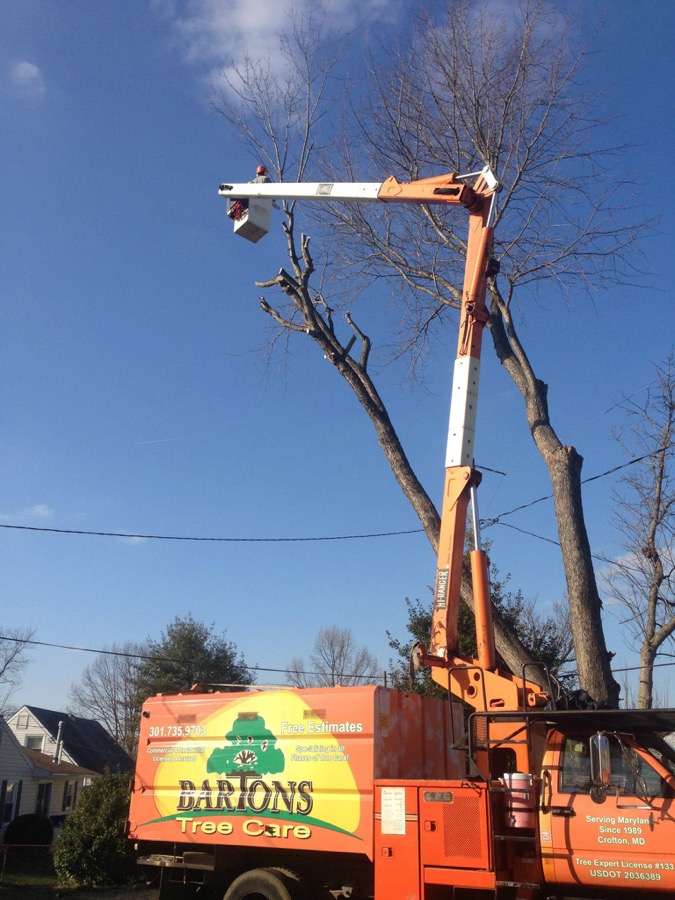
Good pruning starts before the first cut. Barton's evaluates the full tree — its structure, existing defects, growth pattern, and proximity to structures — before deciding what to remove and how to remove it. Every cut is made at the right location, at the right angle, with the intent of preserving the tree's natural healing response and supporting long-term health.
The goal is a structurally sound tree that doesn't require constant intervention. Selective pruning done correctly means cleaner wound closure, less decay entry, and fewer failure points down the road. If a tree has been improperly pruned before, we can assess the current condition and establish a better path forward.
Call (410) 710-0164Licensed oversight, sound technique, and 30+ years of working with Maryland trees.
All pruning work is performed under licensed arborist supervision. MD Tree Expert License #133 & #1883. You're not paying for guesswork. You're getting professionals who understand tree biology and how cuts affect long-term health.
Topping destroys a tree's structure, creates massive decay entry points, and generates fast-growing, weakly-attached regrowth that becomes a hazard within a few years. We don't top trees. If another company offers to, that's a red flag. Walk away.
We know the species common to Maryland: oaks, maples, tulip poplars, and white pines. We know their growth patterns, failure modes, and what pruning approach works best for each. That knowledge doesn't come from a manual.
Answers to the questions homeowners most commonly ask about tree trimming and pruning.
Call Barton's Tree Care for a free quote. We serve homeowners across Maryland and have since 1989.
Owner Direct: (443) 306-3037