Some trees can't be dropped in sections — they need to be lifted clear. Barton's Tree Care operates with crane capability for large, structure-adjacent, and limited-access removals where controlled lifting makes the difference.
Crane-assisted tree removal is a specialized approach used when conventional sectioning from the top isn't practical or safe. Instead of dropping pieces, the crane holds each section under controlled tension as it's cut — then lifts it clear and sets it down in a designated landing zone away from the structure, the yard, or other obstacles. Barton's Tree Care uses this method as part of a broader tree removal capability for situations where the job genuinely calls for it — large trees, limited drop zones, and removals close to homes and structures throughout Crofton, MD and the surrounding Maryland communities.
A crane isn't the right tool for every removal. These are the site conditions where controlled lifting provides a meaningful advantage.
When a tree is positioned directly over a roof, garage, fence, or other structure, there's often no safe path to drop sections without risk of contact. A crane lifts pieces straight up and away, bypassing the structure entirely.
Traditional sectioning requires open ground for debris to land. Properties with dense landscaping, hardscaping, parked vehicles, or neighboring structures may leave no safe fall corridor — making controlled lifting the practical solution.
Very large trees produce sections of significant weight that are difficult to control on the way down. A crane takes that weight and holds it during the cut, giving the climber a controlled working environment instead of relying entirely on rigging lines.
Crane reach extends over obstacles that ground equipment can't cross — tight gates, soft or sloped ground, and confined yards. The crane works from a stable position outside the problem area while the boom reaches over it.
Crane removal is a coordinated operation between the crane operator, the climber in the tree, and the ground crew below. Every step is sequenced before the first cut is made.
Before any equipment is positioned, the site is assessed in full. Crane placement, rigging attachment points, landing zone location, and the sequence of cuts are all determined based on the tree's size, lean, and proximity to structures. We don't improvise on crane jobs.
A climber rigs each section from above while the crane holds it under tension. The section is cut, lifted clear of the tree and any obstacles, and set down in the designated landing zone. This repeats section by section until the canopy and trunk are cleared.
Once the tree is down, all sections, limbs, and debris are processed and hauled off-site. The stump can be ground below grade or left flush at the same visit. We don't leave until the property is clear.
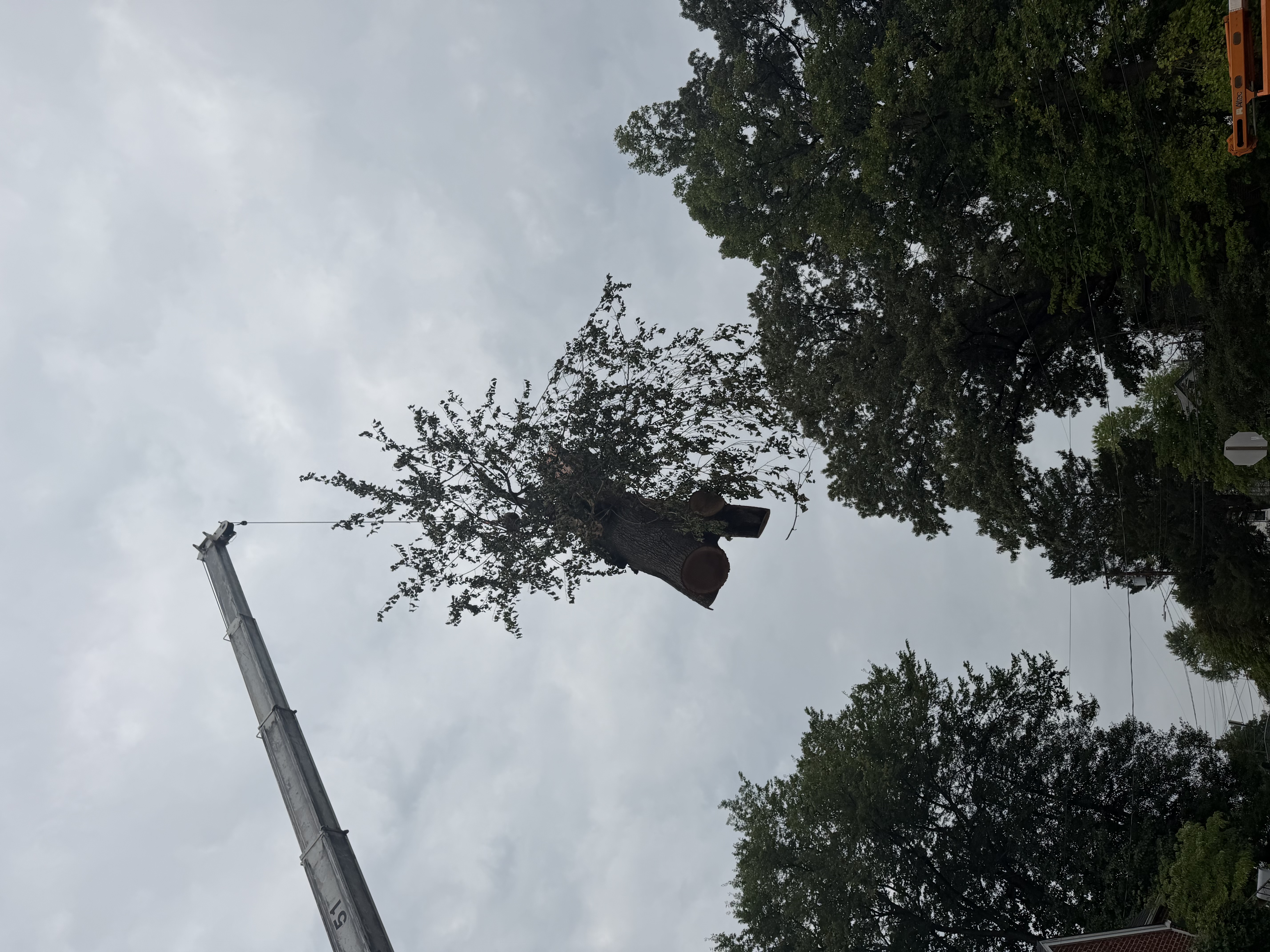
Each section is rigged from above before the cut is made. The crane takes the weight, the cut is completed, and the section is lifted clear — moving vertically away from the structure rather than swinging or dropping toward it. The ground crew guides it into the landing zone while the climber repositions for the next cut.
This approach is more involved than standard removal, and that's the point. When a tree is over a house or in a position where dropping sections isn't an option, the extra coordination is what makes a clean, controlled removal possible. After the tree is cleared, stump grinding can typically be handled in the same visit.
Call (410) 710-0164Crane work requires more than equipment. It requires the experience to plan each lift correctly and the crew coordination to execute it safely on a real property.
Barton's has operated with crane capability on difficult removals for decades. Crane work is part of the full-service removal operation — not a one-off subcontract. The crew that plans the job executes it.
We hold MD Tree Expert License #133 & #1883. For any removal — crane-assisted or otherwise — you're working with properly licensed professionals who carry the appropriate insurance for the work being done.
Ed Barton III has been doing tree work in Maryland since 1989. Difficult removals — the ones over houses, in tight yards, or requiring specialized rigging — are the jobs Barton's has been doing throughout Anne Arundel County for over three decades.
Answers to the questions homeowners most commonly ask about crane-assisted removal.
Call Barton's Tree Care for a free site assessment and quote. Based in Crofton, serving Maryland since 1989.
Owner Direct: (443) 306-3037